
Forming an LLC sounds simple at first. You file some paperwork, pay a state fee, and your business becomes official.
That is the clean version.
The real cost depends on your state, whether you file yourself or hire a registered agent, whether you need business licenses, and how much help you want with things like an operating agreement, an EIN, compliance reminders, and tax setup.
For some business owners, forming an LLC can cost less than $100 in state fees.
For others, the first-year cost can easily reach $500, $800, or even more once you add registered agent service, business licenses, annual reports, publication costs, and professional help.
So, how much does it really cost to form an LLC?
A basic DIY LLC usually costs between $50 and $300 in state filing fees.
A more complete setup with a registered agent, operating agreement, business license, and compliance support may cost between $300 and $1,000+ in the first year, depending on your state and business type.
What Is the Basic Cost to Form an LLC?
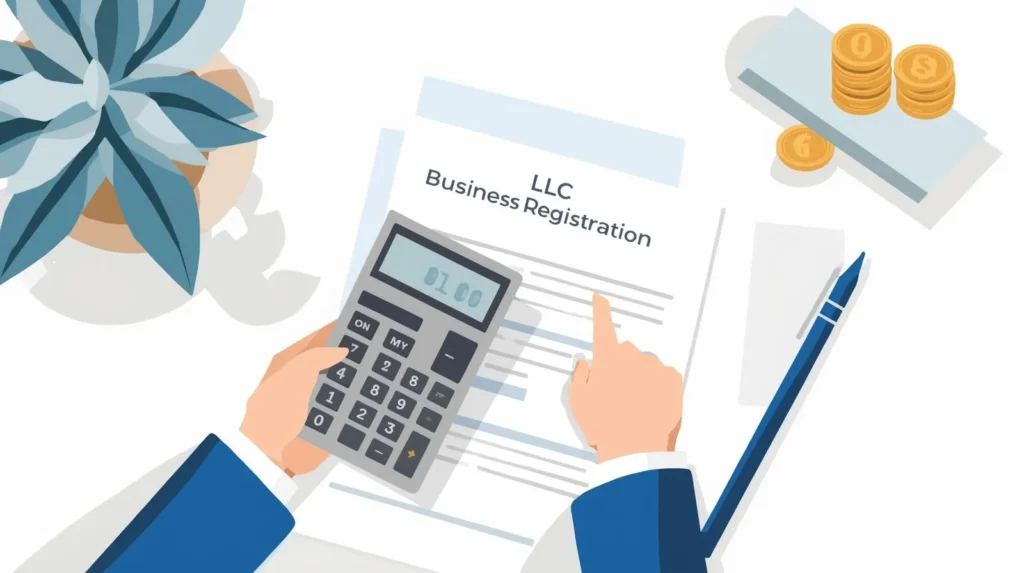
The basic cost to form an LLC is the state filing fee.
This is the fee you pay to your state when you submit the official LLC formation document. Depending on the state, this document may be called:
• Articles of Organization
• Certificate of Formation
• Certificate of Organization
The filing fee varies widely by state.
Some states charge relatively low filing fees, while others charge higher upfront costs or add extra first-year requirements.
A typical LLC filing fee may range from $50 to $300, but some states have higher fees when additional required filings are included.
For example, some states only charge a single formation fee. Others require additional filings, such as an initial report, a publication notice, a business license, or an annual registration fee.
That is why the “real cost” of forming an LLC is not always just the formation fee.
Main LLC Startup Costs
Here are the most common costs you may face when forming an LLC.
| LLC Cost Item | Typical Cost Range |
|---|---|
| State filing fee | $50 to $300+ |
| Registered agent service | $0 to $300 per year |
| Operating agreement | $0 to $200+ |
| EIN | Free if you apply directly |
| Name reservation | $10 to $75 |
| DBA or trade name | $10 to $100+ |
| Business license | $0 to $500+ |
| Publication requirement | $40 to $1,500+ |
| LLC formation service | $0 to $300+ plus state fees |
| Attorney help | $300 to $1,500+ |
| Accountant or tax consultation | $100 to $500+ |
| Annual report or renewal | $0 to $800+ depending on state |
| Franchise tax or annual tax | $0 to $800+ depending on state |
Not every LLC pays every cost.
A simple one-owner consulting LLC may only pay the state filing fee and maybe an annual report fee.
A restaurant, construction company, rental property business, ecommerce seller, or multi-member LLC may have additional licensing, tax, insurance, and professional setup costs.
Cost 1: State Filing Fee
The state filing fee is the main required cost to create an LLC.
You pay this fee when you file your LLC formation document with the state.
This fee depends entirely on where you form your LLC.
Some states are cheaper. Some are more expensive. A few states look affordable at first but have higher annual costs later.
For example, one state may charge a low formation fee but require a high annual franchise tax. Another state may charge more upfront but have cheaper yearly maintenance.
How Much Should You Expect to Pay?
Most business owners should expect to pay somewhere between $50 and $300 for the initial LLC state filing.
However, the filing fee is only the starting point.
Before choosing a state only because it has a low filing fee, look at:
• Annual report fees
• Franchise taxes
• Registered agent requirements
• Business license costs
• Publication requirements
• State tax rules
• Foreign LLC registration requirements
The cheapest filing fee does not always mean the cheapest LLC long term.
Cost 2: Registered Agent
Every LLC needs a registered agent.
A registered agent is the person or company that receives legal documents, official state notices, tax notices, and service of process for your LLC.
You can often act as your own registered agent if you have a physical address in the state where your LLC is formed.
That can cost $0.
But many business owners hire a professional registered agent service instead.
How Much Does a Registered Agent Cost?
A registered agent service usually costs between $100 and $300 per year.
Some may charge less. Some premium services may charge more.
Should You Pay for a Registered Agent?
You may want to hire a registered agent if:
• You work from home
• You want more privacy
• You do not want your address in public records
• You travel often
• You do not keep normal business hours
• You formed an LLC in a state where you do not live
• You do not want legal papers delivered in front of customers or family
If you are comfortable listing your own address and you are available during business hours, you may be able to save money by serving as your own registered agent.
But privacy and reliability are the two big reasons many people pay for this service.
Cost 3: Operating Agreement
An operating agreement is an internal document that explains how your LLC is owned, managed, and operated.
It can cover:
• Ownership percentages
• Member contributions
• Profit and loss sharing
• Voting rights
• Management authority
• Member responsibilities
• Banking authority
• Rules for adding members
• Rules for removing members
• What happens if a member leaves
• How disputes are handled
• How the LLC can be closed
Even if your state does not require you to file an operating agreement, you should still have one.
How Much Does an Operating Agreement Cost?
An operating agreement can cost:
• $0 if you write your own using a basic template
• $50 to $200+ if you use an online service
• $300 to $1,500+ if an attorney drafts a custom agreement
For a simple single-member LLC, a basic operating agreement may be enough.
For a multi-member LLC, it is usually worth getting stronger legal help. Ownership disputes can become expensive quickly, especially when money, voting rights, or exit terms are unclear.
Cost 4: EIN

An EIN, or Employer Identification Number, is a federal tax ID number for your business.
You may need an EIN to:
• Open a business bank account
• Hire employees
• File certain tax returns
• Apply for business credit
• Set up payroll
• Work with payment processors
• Keep business and personal finances separate
How Much Does an EIN Cost?
An EIN is free if you apply directly with the IRS.
Some LLC formation companies charge extra to get an EIN for you. That can be convenient, but it is not required for many business owners.
If you are comfortable doing it yourself, this is one area where you can save money.
Cost 5: Name Reservation
Name reservation is optional in many states.
It lets you reserve your desired LLC name before you officially form the LLC.
This can be useful if you found a name you like but are not ready to file yet.
How Much Does Name Reservation Cost?
Name reservation usually costs around $10 to $75, depending on the state.
Do You Need to Reserve Your LLC Name?
Usually, no.
If you are ready to form your LLC now, you can often skip name reservation and file the LLC directly.
Name reservation only makes sense if you need extra time and want to prevent someone else from taking the name before you file.
Cost 6: DBA or Trade Name
A DBA, also called a trade name, assumed name, or fictitious name, lets your LLC operate under a name different from its legal name.
For example, your legal LLC name may be:
Blue Ridge Ventures LLC
But your public business name may be:
Blue Ridge Web Studio
In that case, you may need a DBA or trade name registration.
How Much Does a DBA Cost?
A DBA often costs between $10 and $100+, depending on the state, county, or city.
Some places require renewal. Some may also require publication.
Do You Need a DBA?
You may need a DBA if:
• Your LLC uses a brand name different from its legal name
• Your invoices use a different name
• Your website uses a different business name
• Your local license requires the public-facing name
• Your bank asks for DBA documentation
If you only operate under your LLC’s exact legal name, you may not need one.
Cost 7: Business Licenses and Permits
Forming an LLC does not automatically give you permission to operate every type of business.
You may still need licenses or permits.
This depends on:
• Your state
• Your city
• Your county
• Your industry
• Your business activity
• Whether you sell taxable goods or services
• Whether you have employees
• Whether you operate from home
• Whether customers visit your location
How Much Do Business Licenses Cost?
Business license costs can range from $0 to $500+.
Some businesses pay very little. Others pay much more, especially if they work in regulated industries.
You may need licenses for:
• Restaurants
• Food trucks
• Contractors
• Salons
• Childcare businesses
• Healthcare services
• Real estate businesses
• Alcohol-related businesses
• Transportation companies
• Retail stores
• Home-based businesses
• Short-term rentals
• Professional services
For example, a freelance writer may not need much beyond basic tax registration. A restaurant may need food permits, health inspections, local licenses, signage permits, and employer accounts.
This is one of the biggest reasons LLC startup costs vary so much.
Cost 8: Publication Requirement
A few states require LLCs to publish a legal notice after formation.
This means you must pay a newspaper to run a notice that your LLC has been formed.
Publication can be one of the most annoying hidden LLC costs because it is easy to miss.
How Much Does Publication Cost?
Publication can cost anywhere from $40 to $1,500+, depending on the state, county, and newspaper.
Some counties are inexpensive. Others are very expensive.
Do All States Require Publication?
No.
Most states do not require LLC publication.
But if your state does, you need to include that cost in your budget.
If you skip a required publication step, your LLC may face compliance issues.
Cost 9: LLC Formation Service

You can form an LLC yourself, or you can hire an LLC formation service.
A formation service usually helps you:
• Prepare the filing
• Submit documents to the state
• Provide a basic operating agreement
• Offer registered agent service
• Send compliance reminders
• Help with EIN filing, if selected
• Provide business document templates
How Much Does an LLC Formation Service Cost?
Many LLC formation services charge anywhere from $0 to $300+, plus state fees.
Some advertise free LLC filing, but you still pay the state filing fee.
Also, watch for add-ons.
The advertised price may not include:
• Registered agent renewal
• EIN service
• Operating agreement
• Compliance alerts
• Business license research
• Expedited filing
• Tax consultation
• Annual report filing
Formation services can be useful, but review the total checkout price carefully before paying.
Cost 10: Attorney Fees
You do not always need an attorney to form a simple LLC.
Many single-member LLCs can be formed without legal help.
But attorney help may be worth it if:
• You have multiple owners
• You are bringing in investors
• You are buying property
• You are forming a professional business
• You need custom ownership terms
• You are splitting profits in a special way
• You have high liability risk
• You are converting from another business structure
• You need contracts or legal strategy
How Much Does an Attorney Cost?
Attorney fees can range from $300 to $1,500+ for LLC formation help.
More complex situations can cost more.
For a simple one-owner LLC, legal help may be optional. For a multi-member LLC, custom legal help can save major problems later.
Cost 11: Accountant or Tax Professional
An accountant is not always required to form an LLC, but tax guidance can be very useful.
A tax professional can help you understand:
• Default LLC taxation
• Self-employment tax
• Sales tax
• Payroll tax
• State tax registration
• S corp election timing
• Bookkeeping setup
• Estimated taxes
• Deductible business expenses
How Much Does Tax Help Cost?
A basic tax consultation may cost around $100 to $500+, depending on the professional and your situation.
If you need ongoing bookkeeping, payroll, or business tax filing, costs can be higher.
For many LLC owners, tax guidance is worth considering once the business earns consistent income.
Cost 12: Annual Reports and Renewal Fees
Many states require LLCs to file an annual or biennial report.
This report keeps your business information current with the state.
It may ask for:
• LLC name
• Principal office address
• Registered agent information
• Member or manager information
• Business contact details
• Filing fee payment
How Much Do Annual Reports Cost?
Annual report fees vary widely.
Some states charge nothing or a small fee. Others charge much more.
Typical costs may range from $0 to $300+, but some states have higher annual taxes or franchise fees.
Why This Cost Matters
Many business owners focus only on the formation fee and forget annual costs.
That is a mistake.
The first-year cost matters, but the long-term cost matters more.
Before forming an LLC, check:
• Initial filing fee
• Annual report fee
• Franchise tax
• Registered agent renewal
• Business license renewal
• Local permit renewals
• State tax obligations
An LLC is not a one-time expense. It has ongoing maintenance costs.
Cost 13: Franchise Tax or Annual Business Tax
Some states charge LLCs an annual franchise tax, minimum tax, or business privilege tax.
This may apply even if your LLC does not make much profit.
How Much Can Franchise Tax Cost?
It depends heavily on the state.
Some states have no franchise tax for most LLCs. Others charge a flat amount or a fee based on income, revenue, capital, or business activity.
In some states, the annual cost can be hundreds of dollars.
This is why choosing the state carefully matters.
If you form an LLC in a state with a high annual tax but your business does not actually operate there, you may create unnecessary costs.
Should You Form an LLC in a Cheap State?
Many business owners ask this question.
They see one state with a low filing fee and another with a high filing fee, then assume the cheaper state is better.
Not always.
In most cases, you should form your LLC in the state where your business actually operates.
If you form in another state but do business in your home state, you may need to register as a foreign LLC in your home state.
That can mean:
• Two state filing fees
• Two registered agent requirements
• Two sets of reports
• Extra compliance work
• Higher total cost
For example, if you live and operate in State A but form your LLC in State B, State A may still require foreign registration. That can make the “cheap” option more expensive.
DIY LLC vs. Formation Service: Which Costs Less?

A DIY LLC usually costs less.
You pay the state filing fee and handle the steps yourself.
This may work well if:
• You have a simple single-member LLC
• You understand the filing process
• You do not need extra help
• You are comfortable applying for an EIN
• You can create a basic operating agreement
• You can track annual report deadlines
A formation service costs more, but it can save time.
It may make sense if:
• You want help preparing the filing
• You want a registered agent included
• You want compliance reminders
• You want templates and document support
• You are worried about making mistakes
• You prefer convenience
The key is to check the full price, not just the advertised price.
Some services start cheap but make money through add-ons and renewals.
Low-Cost LLC Setup Example
Here is what a low-cost DIY LLC might look like:
| Expense | Cost |
|---|---|
| State filing fee | $100 |
| Registered agent | $0, if you serve yourself |
| EIN | Free |
| Operating agreement | Free basic template |
| Business license | $0, if not required |
| Total estimated first-year cost | $100 |
This is possible for a simple business in a low-cost state with no extra licenses.
But not every business will qualify for this low-cost setup.
Mid-Range LLC Setup Example
Here is what a more realistic first-year LLC setup might look like:
| Expense | Cost |
|---|---|
| State filing fee | $100 |
| Registered agent service | $125 |
| Operating agreement | $50 |
| Business license | $100 |
| Annual report | $50 |
| Total estimated first-year cost | $425 |
This is a common type of budget for many small businesses.
It includes more than just the formation fee and gives you a better picture of real startup cost.
Higher-Cost LLC Setup Example
Some LLCs cost much more to launch.
| Expense | Cost |
|---|---|
| State filing fee | $200 |
| Registered agent service | $150 |
| Attorney-drafted operating agreement | $750 |
| Business licenses and permits | $300 |
| Publication requirement | $600 |
| Annual franchise tax | $800 |
| Total estimated first-year cost | $2,800 |
This kind of setup may apply to businesses in expensive states, businesses with multiple owners, or businesses that need professional help and licenses.
Hidden LLC Costs Many People Miss
Here are the costs that surprise new LLC owners most often:
1. Annual Fees
Some states charge yearly reports, renewals, franchise taxes, or registration fees.
Do not assume your only cost is the formation filing.
2. Registered Agent Renewal
If your first year of registered agent service is free through a formation company, check the renewal price.
The second-year cost may be much higher than expected.
3. Business Licenses
Your LLC may need local or industry licenses before operating legally.
This is separate from forming the LLC.
4. Sales Tax Registration
If you sell taxable products or services, you may need state tax registration.
5. Publication Fees
A few states require LLC publication, and the cost can vary sharply by county.
6. DBA Fees
If you operate under a different brand name, you may need a DBA or trade name registration.
7. Bookkeeping Software
You may need accounting software, invoicing tools, payroll software, or payment processing systems.
8. Insurance
An LLC helps with liability protection, but it does not replace business insurance.
You may still need general liability insurance, professional liability insurance, workers’ compensation, commercial auto insurance, or property coverage.
9. Foreign LLC Registration
If you form an LLC in one state but operate in another, you may need foreign registration.
This can double your costs.
10. Professional Help
Legal, tax, and accounting support can add cost, but it can also prevent expensive mistakes.
Is an LLC Worth the Cost?

For many business owners, yes.
An LLC can be worth the cost because it gives your business a separate legal identity and helps protect your personal assets.
It can also make your business look more professional to:
• Clients
• Banks
• Vendors
• Payment processors
• Lenders
• Investors
• Business partners
A sole proprietorship may be cheaper, but it does not give the same liability separation.
If your business is very small, low-risk, and still in the testing stage, you may not need an LLC immediately.
But if your business earns steady income, signs contracts, serves customers, owns equipment, hires help, or carries risk, an LLC is usually worth considering.
How to Reduce LLC Formation Costs?
You can reduce LLC costs by being careful about what you pay for.
Here are practical ways to save money:
• File the LLC yourself if your situation is simple
• Avoid unnecessary name reservation if you are ready to file
• Apply for the EIN yourself for free
• Use a basic operating agreement if you are a single-member LLC
• Serve as your own registered agent if privacy is not a concern
• Avoid expensive add-ons you do not need
• Understand annual costs before choosing a state
• Check license requirements before launching
• Keep track of annual report deadlines to avoid late fees
Do not cut corners on things that matter, though.
For example, a multi-member LLC should not use a weak operating agreement just to save money. That can create bigger problems later.
How Much Should You Budget for an LLC?
A safe first-year budget for a simple LLC is usually around $300 to $700.
This gives you room for:
• State filing fee
• Registered agent service
• Operating agreement
• Business license
• Annual report or renewal
• Basic compliance costs
If your state has high fees, publication requirements, franchise taxes, or expensive licenses, budget more.
If your LLC has multiple owners or legal complexity, budget for attorney or accountant help.
Final Verdict
The real cost to form an LLC depends on your state, business type, and setup choices.
At the lowest end, you may form an LLC for just the state filing fee, often somewhere around $50 to $300.
A more realistic first-year cost for many small business owners is $300 to $1,000+, especially when you include registered agent service, operating agreement, business licenses, tax registration, and annual fees.
The biggest mistake is looking only at the state filing fee.
That number matters, but it is not the full cost.
Before forming an LLC, look at the complete picture:
• Initial filing fee
• Registered agent cost
• Operating agreement
• EIN
• Business licenses
• Annual report
• Franchise tax
• DBA or trade name
• Publication requirement
• Tax and accounting help
An LLC is not just a piece of paperwork. It is a business structure.
If your business is serious, the cost is usually worth it because it gives you liability protection, cleaner finances, stronger credibility, and a better foundation for growth.